This is last Friday's "Iraq snapshot:"
Friday, September 2, 2022. The number of assaults within the US military continue to increase, The October Revolution returns to the streets of Baghdad, and much more.
Allison Jaslow is an Iraq War veteran and a member of Iraq and Afghanistan Veterans of America. She is in the news today because of an interview she gave this morning. CNN reports:
An Iraq War veteran and former Democratic Party official on Friday criticized the presence of US Marines in the backdrop of President Joe Biden's speech in Philadelphia, during which he issued stinging political criticism of Republicans.
She's on solid ground with that critique and she's not the only one making it. CNN's Jeff Zeleny Tweeted:
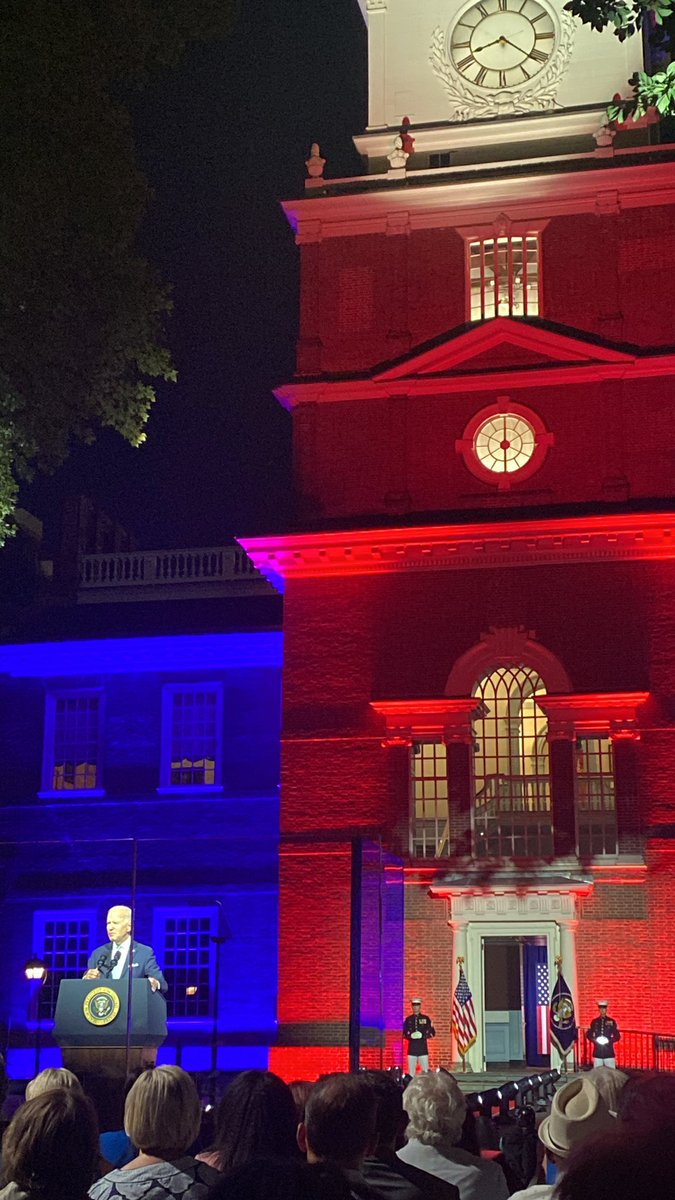
It's not a minor issue but expect the usual nonsense from the partisan patrol that poses as leftists and pretends to be fact based.
Let's stay with Allison for a bit more.
MILITARY TIMES editor Leo Shane III Tweeted:
To which Allison replied:
Fighting like hell? I call bulls**t. Changing the motto outside
front door to be more welcoming to women veterans should be a lay up, but there's been 19 months of inaction by
on it. #ChangeTheDamnMotto
And the motto goes to the lack of welcoming which goes to the reality of the way so many are treated within the military. Allison more recently Tweeted:

And she reTweeted veteran and journalist Paul Szoldra on the same topic:

Senator Kirsten Gillibrand has been a fierce fighter on this issue (even calling out some members of her own party when needed). Her office issued the following:
Senator Gillibrand: “This data shows a military in a crisis…We are betraying the trust of service members and their families and failing the most heroic among us.”
Today, Senator Kirsten Gillibrand, chair of the Senate Armed Services Personnel Subcommittee, responded to the release of the Department of Defense’s (DoD) Fiscal Year 2021 Annual Report on Sexual Assault in the Military. The survey showed that 8.4% of active duty women and 1.5% of active duty men reported at least one unwanted sexual contact in the prior year, amounting to an estimated 35,900 total active duty service members – a disturbing rise from previous years.
For years, Senator Gillibrand has fought the DoD to fundamentally reform how it deals with sexual assault among its ranks. She earned bipartisan majority support for her bill, the Military Justice Improvement & Increasing Prevention Act, which was blocked from receiving a vote in the full U.S. Senate.
In response to today’s shocking numbers, Gillibrand said: “This data shows a military in a crisis. Nearly one in ten active duty women reported unwanted sexual contact during a single year, and that number rises to one in four when the service member experienced an unhealthy command climate involving sexual harassment. When service members cannot trust their leaders to uphold the values of our military services it means we are failing. Finally, the percentage of cases preferred for court-martial charges continues to drop. These results are completely unacceptable.
“We are betraying the trust of service members and their families and failing the most heroic among us. The current versions of the National Defense Authorization Act in Congress contain vital military justice reforms that I have fought for for nearly a decade, and they should be passed and enacted with the urgency this crisis demands.”
The DoD’s full report can be viewed here.
Let's move over to Iraq where the press so frequently gets things wrong. Let's start with ASIA TIMES because they've always been a garbage outlet but they tend to fool so many. They're pimping a neocon whose sucked on the US government tit off and throughout his pathetic career. His name is Hussain Abdul-Hussain and he's a 'journalist.' He's a fool, an idiot and a whore and it's telling that ASIA TIMES wants to publish his latest garbage.
Ten months after Iraq’s pro-Iran bloc was soundly defeated in parliamentary elections, and less than a week after Shia cleric Muqtada al-Sadr announced his retirement from political life, a stalemate between Shiites who oppose Tehran and those who support it seems to be leading the country toward civil war. Yet this is only half the story.
Yes, that is only half the story. For example, the other half goes to the fact that the militias (that his pro-Iran bloc) were disenfranchised and I know the US government doesn't like that reality to be told but it is a reality.
I am not a fan of the militias, I have called them out forever and a day. I strongly called out the move to make them part of the Iraqi security forces. I still think that was a mistake. Epic mistake.
But I'm not a whore. The prime minister, at the last minute, pulled them out of early voting. They weren't allowed to take part in the election as a result since they had to be stationed throughout Iraq on election day (to protect polling places). Mustafa al-Kadhimi does not like the militias because they have mocked him and criticized him. They do not support him so his move to disenfranchise them was not just illegal, it was anti-democratic and the thing a despot does.
A whore, like the one writing for ASIA TIMES, looks to see where the money is. And the US government will always pay those who verbally attack the 'enemy' of the moment. Hussain Abdul-Hussain gets paid for making it all about Iran. Which is why he then types the garbage he does. Iran this and Iran that.
The US gave money to Moqtada al-Sadr -- a killer of US troops. They did that because Moqtada was preferred to the militias. I really think they need to explain to the American people why their tax dollars went to a killer of US troops.
The American people weren't consulted on this. Moqtada was paid off in August of last year (only the latest pay off) to announce that he wanted his cult to vote in the elections held October 10, 2021.
Hussain Abdul-Hussain wants to simplify the issue and make everything about Iraq or Iran. Because that's where the money is and it's where the blood is and a neocon whore like Hussain Abdul-Hussain needs other people's blood to live off of.
Iran and Iraq share a border.
The US government never learns a damn thing.
If you want Iraq and Iran to bicker and the US to benefit, then stay the hell out of it.
It will happen because their border is in dispute. And when it does happen, the US government can't just let it develop, they have to try bring in 800 other issues, "You should be upset about this and about that!" And all that ever does, is remind the two how much the US wants them to be opposed to one another.
The US government is like a stupid person wanting a couple to break up so that they can grab one of the partners. The US always overplays its hand and always makes a concealed motive clear, thereby bringing the couple back together.
Let's got to VOX, believe it or not. Zach's not that smart but I was pleasantly surprised to learn Zach wasn't covering the topic. Jonathan Guyer is:
The ongoing conflict that has paralyzed the country is grounded in complex domestic politics — Sadr himself has long been a powerful figure in Iraqi politics. Its most recent roots, though, start about a year ago in a parliamentary election where Sadr’s movement won the most seats. In the ensuing months, Sadr was unable to secure a majority coalition to his liking, and in July, he urged the parliamentarians from his bloc to resign. But Iraqi politics quickly moved on, and as other parties jostled to form a new government, Sadr’s loyalists held protests outside of government buildings, at one point even occupying the parliament. Meanwhile, religious politics came into play as a prominent cleric in Iran urged his Iraqi followers to break with Sadr.
“For the average Iraqi who was living through that night of terror [Monday], it really felt like going back to the war, in which there was the constant sound of gunfire throughout the night,” [Marsin] Alshamary told me. “We didn’t know whether we would wake up to a civil war in the country.”
To understand why the resignation of a man who has resigned from politics several times before led to street violence, why elite politics in Iraq are so volatile right now, and why many Americans are misunderstanding both (hint: They’re overplaying Iran’s role in the crisis), I spoke with Alshamary, who had just returned from Iraq where she is based. Our conversation has been lightly edited for length and clarity.
[. . .]
JG: He resigned in a tweet on Monday. Does that mean he’s left politics?
MA: Excellent question, because really, he doesn’t make it clear. Muqtada al-Sadr has “left politics” several times before. Usually it’s before elections, because he’s trying to get concessions. We’re not sure what it means this time, because his members of parliament have already resigned. So what more does it mean? That he’s going to withdraw bureaucrats and high-level officials within the government institutions and tell them that they’re no longer participating in the government in any way? Does it mean that he will not make any political statements going forward? He doesn’t clarify.
After Muqtada’s statement on Twitter on Monday about how he’s quitting politics, all hell breaks loose in Baghdad and in the south.
The clashes between the protesters and paramilitary groups grew increasingly violent. We see the kinds of weapons that you would see on a battlefield being brought out. There’s a curfew imposed in Baghdad. The conflict extends beyond the Green Zone, it moves to neighborhoods in Baghdad, particularly ones where the Sadrists are, and we hear news of conflict in cities like Basra, which is the southernmost city in Iraq, Nazriya, and Diwaniya, other important cities in southern Iraq.
For the average Iraqi who was living through that night of terror, it really felt like going back to the war, in which there was the constant sound of gunfire throughout the night. We didn’t know whether we would wake up to a civil war in the country. Most analysts thought that this was going to be a long confrontation between Sadr’s militia — Saraya al-Salam, or the Peace Brigades — and other militias, other Shia militias in Iraq.
But the next day, a little past noon Baghdad time, Muqtada al-Sadr holds a press conference. In this press conference, he looks chastised, he’s apologetic, he apologizes to the Iraqi public for the violence, for what they had to go through that night. He chastises his followers, saying that their movement isn’t violent, that they shouldn’t drag Iraq into corruption and violence, like Iraq is already corrupt, we don’t need more problems. He even reaches a point where he says both those who were killed and the killers are all in hell, which is a very, very strong condemnation of his own followers.
He also gives his followers an hour to leave the Green Zone and to stop all violence. And the effect is instantaneous, by the way. Everyone breathed a sigh of relief when he told them to go because we knew they would follow him.
JG: That’s quite a turnaround. What triggered all of this?
MA: Can I get in the weeds of Shia political authority for a bit? Muqtada al-Sadr, although he wears a turban and looks very much like a cleric, doesn’t have the clerical authority to become a spiritual guide for Shia.
Shia Muslims have to find a particular high-ranking cleric who is able to direct them in personal matters, social matters, and sometimes even political matters. In order to become that person, though, you have to go through a lot of training and reach this level, where you become an ayatollah essentially. Muqtada’s father, who formed the base of the Sadrist movement that we see today, he was both an ayatollah and a social-movement leader.
Muqtada inherited this movement but couldn’t fill in that void of being a spiritual guide. The person who stepped in was someone named Kadhim al-Haeri, who was a student of his father’s and who became the spiritual guide for Muqtada and the movement. Him and Muqtada have had an on-and-off relationship; there were points of disagreement. But prior to Muqtada’s tweet, and what really prompts the tweet, is that last week Haeri releases a statement — keep in mind, he lives in Iran right now — and in the statement, there’s two things that are important.
First, he makes the unprecedented move of abandoning his office and saying he no longer wants to be a spiritual guide for anyone, and that if any of his followers are looking for where to go next, they should go to Khamenei, the supreme leader of Iran. This is unprecedented in the Shia religious establishment; no one gives up their position as a spiritual guide and tells someone to go elsewhere. And it’s very strange why it’s Khamenei who he picks to be the next spiritual guide. This is the first blow in the statement for Muqtada al-Sadr, who built his entire movement around being an Iraqi nationalist and anti-Iranian, to be told that he and his followers should turn to Khamenei.
The second big blow is Haeri criticizes Muqtada in the statement. He says that he is not a true inheritor of the legacy of the Sadr family, this illustrious family of clerics who has been involved in Iraq for decades. He also says that Muqtada al-Sadr is creating this strife and chaos and a lot of tension among the Shia. He never says [Sadr’s] name, by the way, but it’s very clear who he’s talking about.
And this letter must be a slap in the face to Muqtada al-Sadr, to be so criticized by someone so close to your father, that the next day we see this response. So that’s the trigger point.
JG: Many observers in Washington frame all of this around Iran. And obviously, we’re talking about a very influential cleric who is based in Iran, but you’re saying a lot of this has much more to do with Iraqi domestic politics and the complexities of a parliamentary system in a post-civil war country than with outside powers?
MA: I think the simplicity around the Iran rhetoric is that everyone looks at this conflict as though Sadr was this anti-Iranian hero, and the Coordination Framework are the pro-Iranian villains — when in reality, everyone in the story is a villain. Everyone’s relationship with Iran is very complicated. The relationship that’s often portrayed to exist between Iraq and Iran is very much simplified.
To take Muqtada al-Sadr as an example: In many of my meetings and conversations with the Western diplomats, I’m astounded by the degree to which they want to believe that Muqtada al-Sadr will be an anti-Iranian force in Iraq, completely forgetting his violent history against Iraqis, against Americans, and how at the time, he was supported by Iran in those endeavors. Now, I expect them to look away as Iran seems responsible for manipulating Sadr to end the violence. I think they are misunderstanding Sadr’s intentions in being anti-Iranian. He is just trying to capitalize on popular sentiments in Iraq that are anti-Iranian.
There’s also a simplistic narrative around the Coordination Framework that they’re all pro-Iranian militias, when in fact, in the Coordination Framework, you have someone like Haider al-Abadi, the former prime minister during the ISIS war who was close allies with Washington, as well as Ammar al-Hakim, who was a cleric and a politician with ties to the West. So not everyone in the Coordination Framework is a staunch pro-Iranian politician, and Muqtada al-Sadr isn’t reliably anti-Iranian either.
Regardless of all that, what I find really mystifying is the willingness to allow Iraq to burn just so that Iran would lose a little bit of influence, when there is another opportunity to build on the civil society in Iraq, on the protest movement in Iraq that produced new members of Parliament and that produced independent MPs, and to actually support them because they represent the Iraqi street. Actually, they’re anti-Iranian too, but they don’t do it in a way that invites violence and confrontation, but they do it in a way that places Iraq’s interest front and center.
It's an intelligent discussion that deals with reality. She also offers her feeling on the future. She's probably right there as well. I disagree but I may be too hopeful. She, for instance, feels that the next vote will be see either the same low turnout or maybe even worse. I don't see that. I see a higher turnout and, yes, that is based in part on what I hear from people who were members of The October Revolution. Many of them sat out the election due to the corruption. Their attitudes now are about developing politicians to run in the next election, taking part in the next election. (These are a small number of members of The October Revolution and our communications are as individuals -- they are not speaking on behalf of the movement.) I may be giving too much weight to that outcome because, historically, it is the natural outcome.
Moqtada's violence has now spread to Basra. All of Iraq is watching. The October Revolution had a large number of potenial voters who sat out the election. These young Shi'ites sitting it out weren't the only ones. And as they see the violence in Baghdad and now in Basra, I also believe that they will be more likely to show up and vote. Again, I could be wrong.
The occupation of the Parliament triggered a large response that the western media ignored. A large number of Iraqis were outraged by both the occupation of the Parliament and what they saw as the disrespect taking place during the occupation.
Again, I could be wrong about what would happen at the next election.
Read her observations and insight. She's probably more on the mark than I am.
The leader of Iraq's Iran-backed Asaib Ahl Al-Haq militia, Qais Al-Khazali, yesterday ordered the closure of the militia's offices across the country following violent clashes that erupted in the southern city of Basra during which four people were killed.
In a statement posted on Twitter, Al-Khazali ordered the closure of the militia's offices until further notice and called on his followers not to respond to any provocations.
Earlier yesterday, Reuters reported that four men, including two members of Saraya Al-Salam, an armed faction linked to Shia cleric Moqtada Al-Sadr, were killed in clashes among rival Shia Muslim militants in the southern Iraqi city of Basra.
OIL PRICE notes, "Violence in Baghdad is one thing, and has the potential to mildly move markets as fears increase of threats to the oil industry in OPEC’s second-largest producer nation. Violence in Basra–the heart of Iraqi oil–is quite another thing. This is not a separate incident from what has happened in Baghdad, and that is significant. This is a spreading of the political unrest in Baghdad as rival Shi’ite groups vie for power."
Meanwhile, The October Revolution is back in the streets:
THE NATIONAL's Mina Aldroubi Tweets:
The following sites updated:
-
Shaping a National Latino Museum5 hours ago
-
Juilliard Jazz Ensemble: Tiny Desk Concert6 hours ago
-
-
-
Simple Mushroom Soup in the Kitchen9 hours ago
-
Honest broker10 hours ago
-
The do-nothings10 hours ago
-
One of the most underrated actors11 hours ago
-
Corruption is all around11 hours ago
-
Cher11 hours ago
-
Interview: Paul Craig Roberts11 hours ago
-
-